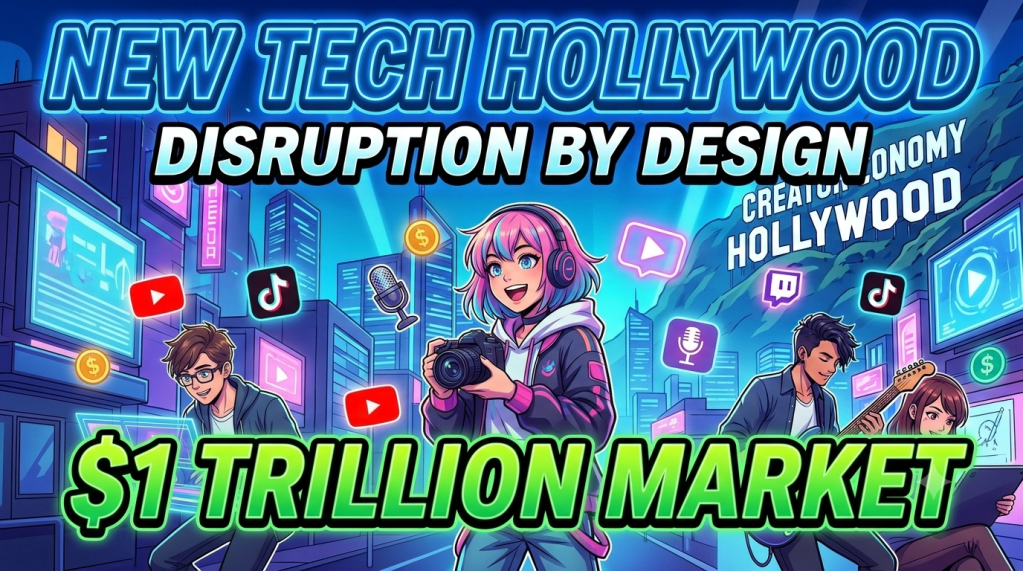
The traditional entertainment industry is currently trapped in a death spiral of its own making. Legacy “blockbuster silos” are collapsing under the weight of bloated $300 million budgets, restrictive gatekeeper bottlenecks, and a fundamental inability to adapt to the “New Tech Hollywood” reality. As production costs soar and audience attention fragmentizer, the old era of one-off transactional sales is being dismantled by a disruptive force emerging from San Francisco’s SoMa district.
Led by Rice Rocket Entertainment, this movement is bypassing predatory middlemen to capture the massive $654 billion converged market. The goal is simple but revolutionary: build the next generation of global franchises in a verticalized powerhouse where fans aren’t just consumers—they are equity-holding stakeholders.
Here is the blueprint for how the rules of intellectual property (IP) are being rewritten for a $1 trillion future.
1. IP is No Longer Linear—It’s a “Transmedia Flywheel”
In the legacy model, a story was a linear product: a movie that might eventually become a toy. Today, that model is obsolete. To win the converged era, IP must travel fluidly through a
Transmedia Flywheel, engineered from day one to exist across four essential nodes:
- Node 1: Interactive Launchpad (Gaming): IP is born and tested in highly engaging, live-service hubs like Roblox or custom-built engines.
- Node 2: Narrative Scale (VOD Adaptation): Lore expands via premium 5G streaming to reach mass-market casual audiences.
- Node 3: Physical Immersion (Premium Merch): High-margin physical collectibles fund the next stage of development.
- Node 4: Sonic Identity (Music Sync): Viral, AI-enhanced music syncs drive algorithmic discovery, pushing users back to Node 1.
As the industry directive states:
“Intellectual property is no longer linear. To win the $654 Billion converged era, IP must travel fluidly.”
This flywheel replaces the “one-hit wonder” risk with an unbeatable differentiation: a continuous ecosystem where every touchpoint reinforces the total franchise value.
2. Gaming Has Evolved into the Lead Engine
Gaming has officially secured its position as a $197 billion titan, reaching parity with VOD and streaming. By 2030, this sector is projected to hit a $350 billion valuation. The “2026 Pivot” marks the death of the hardware-centric, $70-hit model in favor of cross-genre hybrids and community-driven hubs.
| The Old Era | The 2026 Pivot | The 2030 Revenue Driver |
| $70 One-Off Hits | Cross-Genre Hybrids | Cloud & UGC Subscriptions |
| Hardware-Centric | Live-Service Hubs | Super VIP Monetization |
| AAA Bloat | Indie Efficiency | AI-Generated Social Hubs |
The Indie Efficiency Metric proves the disruption. While traditional studios bleed capital, agile titles like R.E.P.O. sold 16.9 million copies at $9.99, generating $136 million and completely out-earning traditional AAA budgets. This is high-velocity digital parity in action.
3. The “Kidult” Economy is Hijacking the Toy Box
The $156.5 billion merchandise market has been hijacked by adults (20+) who now drive 43% of all sales, often spending $500+ per item. This “Kidult” economy transforms physical goods into high-margin investment classes.
Japanese IP is currently leading this charge, growing 3x faster than Western animation and seizing 20% more shelf space. To capitalize, the New Tech Hollywood model utilizes “Phygital” goods—physical collectibles paired with a digital twin. This ensures that physical media persists as an immune, high-margin collectible while providing cross-platform utility in the digital realm.
4. The “Kickstarter Meets Shark Tank” Funding Revolution
The Rice Rocket Disruption is systematically “Bypassing Predatory Middlemen” by utilizing the JOBS Act (Reg CF/A+) to democratize capital. This isn’t just crowdfunding; it’s a strategic assault on legacy gatekeepers.
The infrastructure behind this revolution consists of two proprietary engines:
- Gamespace™: The “WeWork for video games,” a state-of-the-art co-working hub in SoMa that bridges deep Silicon Valley tech prowess.
- BankMe™: A revolutionary funding engine providing unsecured working capital loans to creators, generating fixed interest returns while funding aggressive investor acquisition.
This enables a 50/50 Split model where creators retain 100% IP ownership while splitting net profits with the studio—a sharp contrast to the legacy model where studios own 100% of the IP. Participation is tiered for maximum scale:
- The Creator Program ($500 sign-up): Initiates franchise development for comic book artists and YouTubers.
- The Producer Program ($25,000 sign-up): Provides the “Ignition Fuel” for aggressive global marketing and retail investor campaigns.
5. Equipping the Arsenal: SOMA Digital Media Studios
The SoMa loft is not a mere office; it is a verticalized production powerhouse consisting of specialized sub-studios designed to accelerate rapid IP generation:
- Horrorvision Studios™: High-ROI horror franchises like Rat Monkey.
- Blue Robot Studios™: Advanced animation and world-building.
- Chopstick Films™: Bridging Asian-American cultural crossover IP.
- Superfly Comics™: A dedicated comic-to-film adaptation engine.
- Grapple Music™: Creating viral soundtracks and the “Sonic Identity” for every franchise.
This arsenal fuels projects that drive Average Revenue Per User (ARPU) through social impact. For instance, Lucky Bay Casino™ uses a “Dual-Purpose Engine” to generate mandatory foot traffic for local SF storefronts by requiring physical visits to claim rewards. Simultaneously, the Video Game Academy & Fog City eSports bridge the $200 billion opportunity gap for at-risk youth, providing $500/month salaries and teaching cyber-corporate skills. The competitive peak? The Old School eSports League™, featuring a $1,000,000 prize pool for the open-source RTS game Beyond All Reason (BAR).
6. The Scoreboard: $1 Billion Unicorn Valuation
The financial trajectory for this model is engineered for “Boss Level” liquidity. By focusing on community-owned ecosystems rather than growth-at-all-costs, the revenue projections are aggressive:
- 2026: $1.5 Million (Seed development & SoMa loft acquisition)
- 2027: $100 Million (Market expansion)
- 2028: $250 Million (Projected revenue)
The 5-Year Master Goal is to share $1 billion in total franchise sales and secure over 1 million channel subscribers. This leads directly to the ultimate liquidity event: either an IPO to unlock global public capital or a strategic acquisition by a behemoth like Disney, Apple, or Amazon.
Conclusion: A Community-Driven Future
The era of siloed entertainment is entirely over. The transition from one-off transactional sales to bundled, community-driven ecosystems is the only path to survival in a $1 trillion market.
As the “New Tech Hollywood” thesis concludes:
“Technology, community, and entertainment have converged. The next generation of global franchises will not be built in silos.”
When the fans own the equity, who really controls the story?
 “We believe Raw Studios can help us deliver new and compelling intellectual properties for the mass market,” D2 Comics producer Ludon Lee said. “We are convinced that Raw Studios can gather the best talents in its industry who are looking to cross over into a new age of digital entertainment.”
Leave a comment